
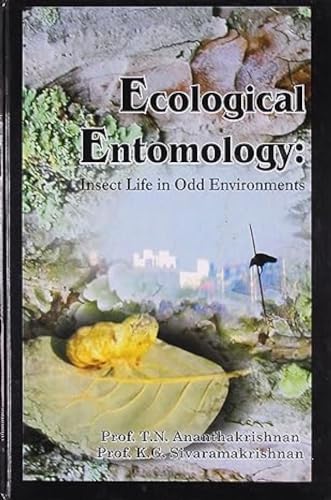
Ecological entomology: insect life in odd environments / by T.N.Ananthakrishnan, K.G. Sivaramakrishnan
Material type: TextPublication details: Jodhpur : Scientific Publishers , c2008Description: xii,142p. : ill.,16 col. plates; 25 cmISBN:
 - 9788172335090
- 595.77
| Item type | Current library | Call number | Copy number | Status | Barcode | |
|---|---|---|---|---|---|---|
 Books
Books
|
CPGS | 595.77 ANA (Browse shelf(Opens below)) | Available | CPGS446 | ||
|
Books
|
CPGS | 595.77 ANA(2) (Browse shelf(Opens below)) | 2 | Available | CPGS447 |
Browsing CPGS shelves Close shelf browser (Hides shelf browser)

|
|
|

|
|
No cover image available |

|
||
| 595.717 SPE;2(2) Ecology of Insects: concepts and applications / | 595.717 SPE;2(3) Ecology of Insects: concepts and applications / | 595.717 SPE;3 (4) Ecology of Insects: concepts and applications / | 595.77 ANA Ecological entomology: insect life in odd environments / | 595.77 ANA(2) Ecological entomology: insect life in odd environments / | 595.774 CHE ENTO/2021 Diversity and abundance of fruit fly species by adoption of parapheromonic traps in Ri-Bhoi district of Meghalaya / | 599.938 HAR:2 Unstoppable us, Vol.2 : why the world isn't fair / |
Includes bibliographical references and index.
Contents:
1. Environmental deterioration and insect diversity spectrum - an introduction.
2. Adaptive diversity of insects to climate and land-use changes.
3. Insects as indicators of environmental quality.
4. Insect biodiversity in Xylophagous and Coprophagous habitats.
5. Canopy ecology and insect biodiversity.
6. Habitat heterogeneity in agroecosystems: insect biodiversity in habitat edges or Ecotones.
7. Litter dynamics in natural and intefered forests.
8. Insect and social forestry.
9. Fern, moss and lichen infesting insects.
10. Insect in gall environments.
11. Aquatic insects in odd environments: habitat specialization from snow melt streams to temporary ponds.
12. Impact of urbanization on insect biodiversity.
13. Land-use changes and dynamics of insect vectors of human disease.
14. Conclusion: conservation for a healthier environment.
There are no comments on this title.